- Email: roswellchildcareacademy@gmail.com
- Phone: 470-282-1521
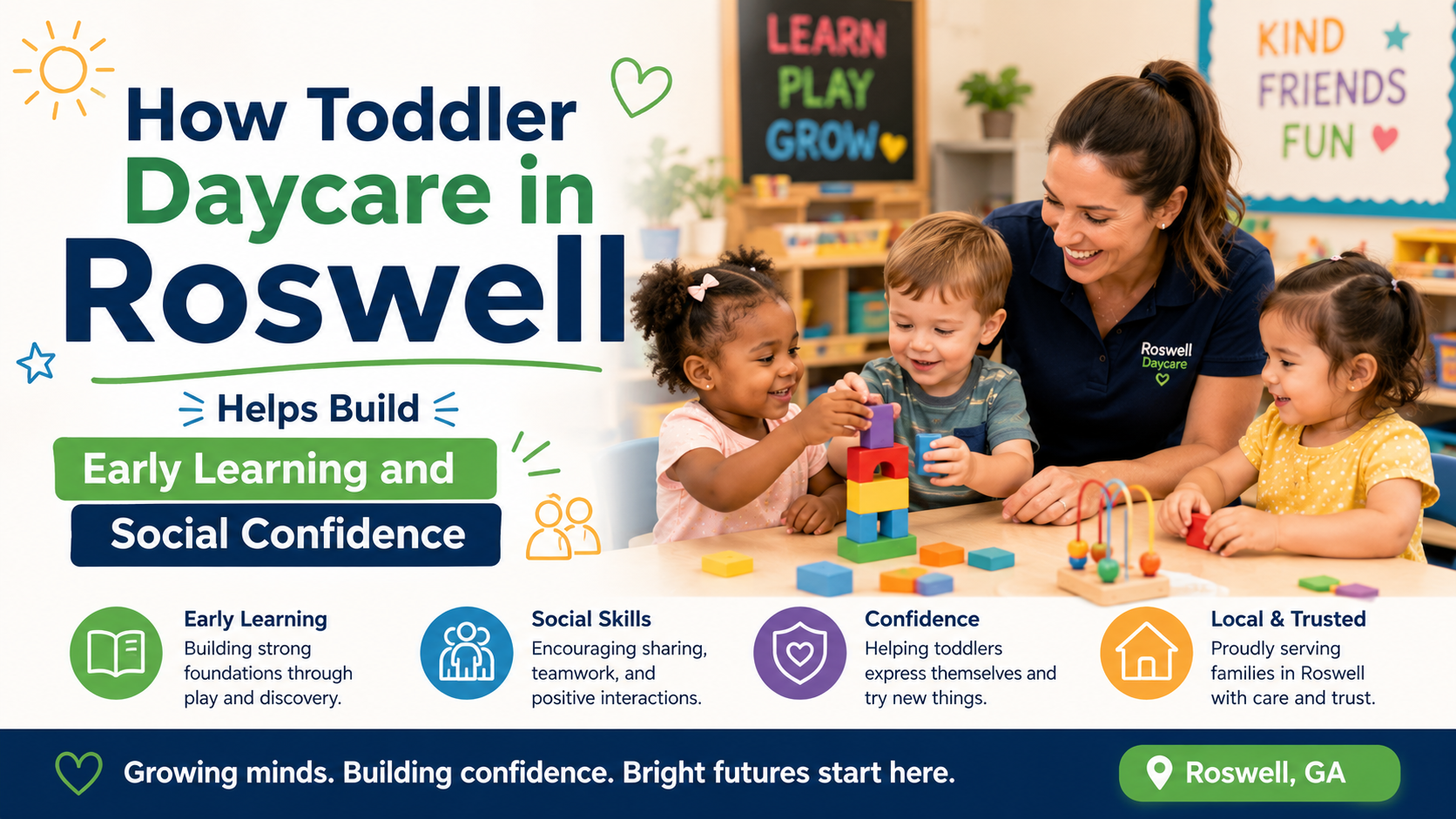
For a lot of families, the answer leads them to look into toddler daycare in Roswell. Maybe you’re heading back to work. Maybe your child has started seeming bored or lonely at home. Maybe you’ve just got a gut feeling that they’d thrive around other kids. Whatever brought you here, the real question underneath it usually isn’t “where can I drop my child off.” It’s “where will my child actually grow?”
That’s a fair thing to want to understand before you hand over the most important person in your life to someone else for forty hours a week.
The toddler years, roughly ages one to three, are a window when the brain is building connections faster than at almost any other point in life. The right environment during this stretch doesn’t just keep a child busy. It shapes how they learn, how they relate to other people, and how confident they feel walking into new situations. This article walks through exactly how good toddler care supports that growth, the mistakes worth avoiding, and what to look for so you can choose with confidence instead of crossed fingers.
Let’s start with what’s actually happening when a toddler spends their day in a well-run program. It looks like play. To a casual observer, it might even look like chaos. But underneath the building blocks and the snack-time spills, a lot of real development is going on.
A good toddler room is built around predictability. Children arrive, hang up their bags, wash their hands, and move into the morning’s first activity in roughly the same order every day. That routine isn’t there to make life easy for staff. Toddlers feel safe when they know what comes next, and a child who feels safe is a child who’s free to explore, ask questions, and take small risks. That sense of security is the foundation everything else is built on.
From there, the learning happens through doing. Toddlers don’t sit and listen to lessons. They learn by stacking cups until they fall, by figuring out that the round block goes in the round hole, by negotiating who gets the red truck. Teachers in strong programs know how to step into these moments and gently stretch them, adding a new word, asking a simple question, showing a different way to try.
A few things experienced early educators tend to notice:
For parents, the consideration here is balance. You want a place that has structure without being rigid, and warmth without being a free-for-all. The best childcare in Roswell tends to land in that middle zone: enough routine to feel calm, enough flexibility to follow a child’s curiosity.
Choosing a program is emotional, and emotion can pull us toward the wrong signals. Here are the slip-ups that tend to trip up even thoughtful, careful parents.
It’s completely understandable. Budgets are real, and a five-minute drive beats a thirty-minute one on a hard morning. But the cheapest or closest option isn’t automatically the right fit. What matters far more is the ratio of teachers to children, how long the staff have stayed, and what the day actually looks like hour to hour. A short commute means very little if your child spends the day under-engaged. Weigh convenience, but don’t let it make the decision for you.
Websites are polished. Photos are staged. The only way to really know a place is to stand in it. Walk through during a normal weekday, not a special open house. Watch how teachers talk to the children. Are they crouching down to a child’s eye level, or calling instructions across the room? Do the kids seem comfortable and busy, or restless and waiting? Your instincts in that room will tell you more than any brochure.
Every toddler has rough days, meltdowns, biting phases, and separation tears. What separates a great program from an average one is how the adults respond when things go sideways. Ask directly: how do you handle a toddler who hits? What happens when a child cries all morning? A thoughtful answer that centers the child’s feelings is a green flag. A vague or punitive one is worth paying attention to.
The practical move across all three of these is simple. Slow down, visit more than once if you can, and ask real questions. The families who feel best about their choice a year later are almost always the ones who took their time at the start.
When people picture daycare, they often picture supervision. But quality care touches nearly every part of how a toddler grows. Here’s how that breaks down across the areas that matter most.
None of this happens overnight. But milestone by milestone, the gains stack up in ways that become obvious by the time a child starts pre-K.
Childcare has shifted in recent years, and parents today expect more than they did a decade ago. The good news is that the best programs have shifted right along with them.
Play-based learning has moved firmly into the mainstream. Rather than drilling toddlers with flashcards, strong programs follow the child’s interests and weave learning into it. A child fascinated by trucks might get counting, color sorting, and new vocabulary, all built around trucks. It works because toddlers learn best when they’re genuinely interested.
There’s also a much stronger focus on emotional skills, sometimes called social-emotional learning. Teachers help children name feelings, calm down, and treat each other kindly. Many parents now see this as just as important as letters and numbers, and they’re right to.
Communication between home and program has changed too. A lot of families in 2026 expect regular updates, often through an app, with photos, notes about the day, and a heads-up about naps and meals. That daily window into your child’s world has become something parents genuinely value, especially in the early weeks when leaving feels hard.
What parents tend to expect now is a blend: real learning, real warmth, real safety, and real communication. A program that delivers all four is the new standard, not a luxury.
There’s no universally “right” answer here, and plenty of children thrive either way. But if you’re weighing a structured program against care at home, it helps to see the trade-offs side by side.
| Feature | Toddler Daycare | Home Care |
|---|---|---|
| Social interaction | Daily contact with peers; lots of practice sharing and cooperating | Depends on play dates and outings; can be limited |
| Routine and structure | Built-in daily rhythm guided by trained staff | Flexible, but takes effort to keep consistent |
| Early learning activities | Planned, age-appropriate activities and materials | Varies with caregiver’s time, energy, and resources |
| Cost | A recurring monthly expense | No tuition, but may mean lost income or a paid sitter |
| Flexibility | Set hours and schedule | Highly flexible around your day |
| Exposure to new experiences | Wide variety of toys, themes, and group activities | Centered on home and family routines |
| Communication development | Constant language exchange with kids and adults | Strong one-on-one talk, fewer peer conversations |
Read this with your own family in mind. A child who lights up around other kids and craves stimulation may flourish in daycare. A more sensitive child, or a family with flexible support at home, might prefer a slower start. Both paths can raise a happy, capable kid. The goal is matching the setting to your child and your life, not chasing someone else’s ideal.
Once you understand the options, the choice gets less overwhelming. Here’s a practical way to work through it.
Start by getting clear on what your child needs right now. A shy toddler might do best in a smaller group with lots of adult attention. A high-energy, social child might thrive somewhere with more room to move and more playmates. Picture your specific child, not a generic one.
Next, make a short list and visit each place in person. Go during regular hours. Trust what you see and feel, not just what you’re told.
Then ask the questions that matter:
Finally, give weight to your gut. You know your child better than anyone. If a place looks perfect on paper but something feels off, that feeling is data. And if a program just feels warm and right, that matters too. The families who settle in happiest are usually the ones who trusted both the facts and their instincts.
Families in Roswell tend to care deeply about giving their kids a strong start, and the area offers real choices for early education. Whether parents are commuting toward Atlanta, working locally, or running a household on shifting schedules, the need is the same: a place where a toddler is safe, engaged, and genuinely cared for during the day.
What’s encouraging is that good daycare in Roswell isn’t only about coverage while parents work. The strongest local programs treat the toddler years as a true learning stage, with routines, early skill-building, and the kind of warm attention that helps a child feel secure. For parents thinking ahead to preschool and kindergarten, that early foundation matters, because confidence and social comfort built now carry forward.
Roswell parents also tend to value community and consistency, and quality childcare in Roswell can offer both: familiar faces, steady routines, and friendships that sometimes last well past the toddler room. For many families, that sense of belonging is a big part of what makes the right program feel like home.
When you tour a program, keep this short checklist in mind. These are the things that separate good care from care that just gets by.
If a program checks these boxes, you’re likely looking at a place that will help your child thrive.
Choosing care for your toddler is one of those decisions that feels enormous, because it is. But it helps to remember what’s really at stake and what’s really possible. The toddler years are a remarkable window for growth, and the right environment can do far more than keep your child safe. It can help them learn, connect, and step into the world with confidence.
We’ve covered a lot here: how quality toddler daycare in Roswell supports cognitive, social, emotional, and language development; the common mistakes to sidestep; what modern programs look like in 2026; and the specific things to look for on a tour. The thread running through all of it is simple. Good early care isn’t about flashcards or fancy facilities. It’s about safety, warmth, routine, real engagement, and people who genuinely care about your child.
If you’re weighing childcare in Roswell, take your time. Visit. Ask questions. Trust what you see and what you feel. The effort you put in now pays off in a child who feels secure, curious, and ready for what comes next. Families exploring daycare in Roswell often find that a thoughtful, nurturing program like Roswell Child Care Academy gives their toddler exactly the steady, encouraging start they were hoping for.
Your child is growing up fast. The right place won’t just watch them do it. It’ll help. When you’re ready, go see a program in person, picture your little one in that room, and choose the place that feels like it’ll cheer your child on every single day.
Most programs accept children as young as infants, but the toddler room generally begins around 12 to 18 months, depending on the center. The right starting age really depends on your child and family situation. Some toddlers settle in quickly, while others need a gentle transition. If you’re unsure, visit a program and talk with the staff about how they ease new toddlers in. Many offer short adjustment days so your child can warm up gradually rather than starting full-time all at once.
Readiness looks different for every child, and there’s no perfect checklist. Signs that often point toward readiness include curiosity about other children, comfort being held or comforted by familiar adults beyond you, and a general interest in exploring. Honestly, many toddlers aren’t fully “ready” and still thrive once they settle in. The bigger factor is finding a warm, patient program that handles the early adjustment with care. A few teary drop-offs at the start are normal and usually fade within a couple of weeks.
Yes, and this is one of the clearest benefits. Toddlers learn social skills like sharing, taking turns, and reading other kids’ feelings mainly through practice with peers, which is hard to replicate at home. In a good program, teachers guide these everyday moments, helping children cooperate and resolve small conflicts. Over time, most toddlers grow noticeably more confident around other children. By the time they reach preschool, kids with early group experience often feel comfortable joining activities and making friends.
Costs vary based on the program, the hours you need, and your child’s age, so it’s best to ask each center directly for current pricing. Toddler care often costs a bit less than infant care because ratios change as children grow. When comparing prices, look beyond the number. Consider what’s included, the teacher-to-child ratio, staff experience, and the quality of the daily program. The lowest price isn’t always the best value, and a slightly higher cost sometimes reflects better care and lower staff turnover.
Most programs send a list, but common items include a change of clothes (or two), diapers and wipes if needed, a comfort item like a small blanket, a labeled water bottle, and any required nap bedding. Label everything with your child’s name. Some centers provide meals and snacks while others ask you to pack them, so check ahead. The first weeks often bring a few extra outfit changes, so erring on the side of more spare clothes is always a safe bet.
Strong programs make communication a priority. Many use an app to share photos, daily notes, meal and nap updates, and developmental observations throughout the day. Beyond that, a quick chat at pickup with your child’s teacher is invaluable, and most welcome it. If a program seems vague about your child’s day or hard to reach, treat that as a warning sign. You deserve a clear window into how your toddler is doing, especially during the early weeks when leaving them feels hardest.
Completely normal, and it doesn’t mean you’ve made the wrong choice. Separation tears are a healthy sign of attachment, and most toddlers calm down within minutes of you leaving. A good program will reassure you and may even share a photo once your child has settled. The crying usually fades over the first few weeks as your toddler learns the routine and builds trust with their teachers. Quick, confident goodbyes tend to help more than long, drawn-out ones.
It builds the foundation in quiet, everyday ways. Through routines, group play, and structured learning delivered through fun, toddlers grow comfortable being away from home, following simple directions, and getting along in a group. These are the real building blocks of preschool readiness, far more than knowing letters or numbers early. By the time a child moves up, they often already feel confident in a classroom setting, which makes the jump to preschool smoother for both the child and the parents.




Comments are closed