- Email: roswellchildcareacademy@gmail.com
- Phone: 470-282-1521
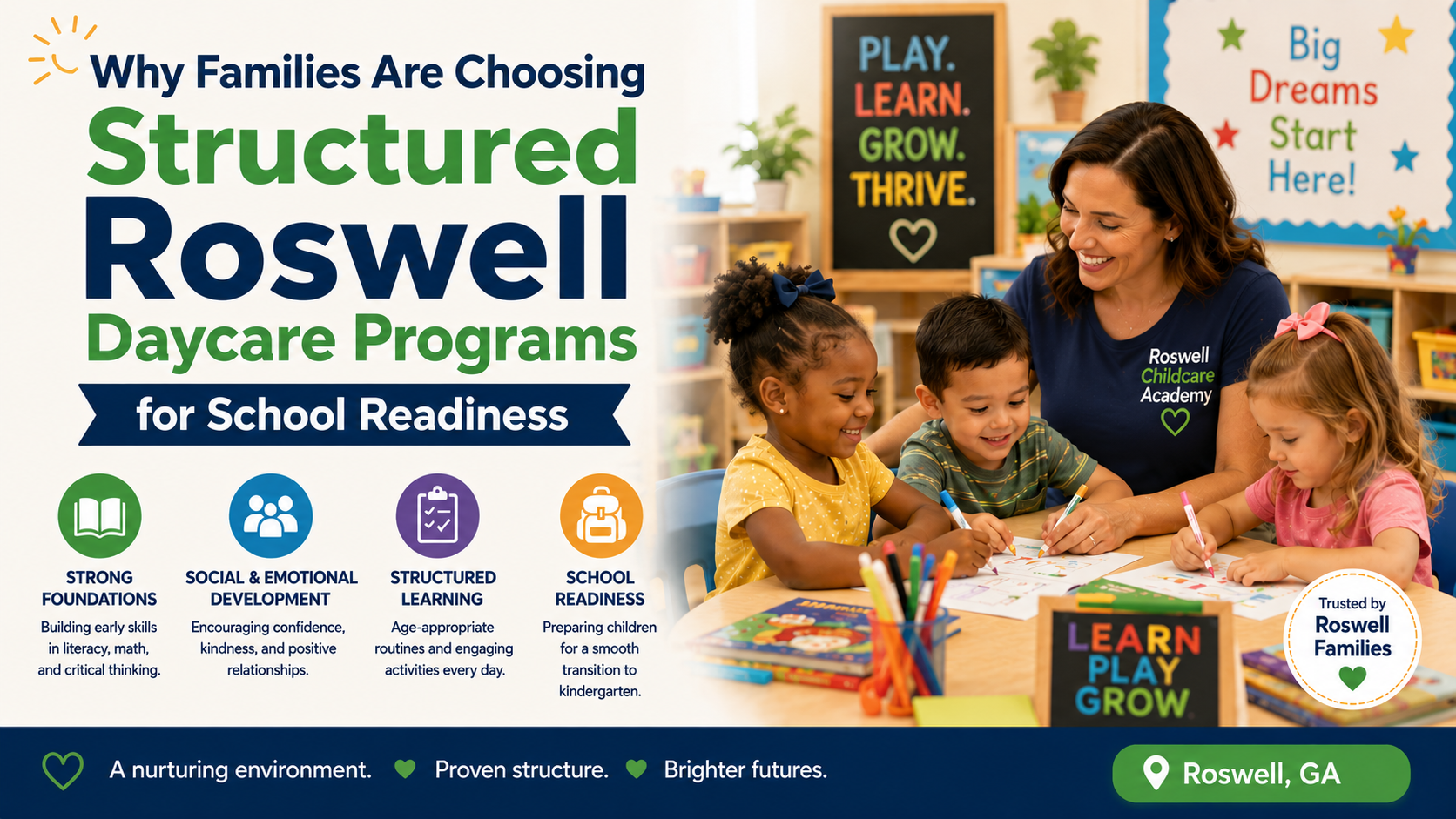
If you’ve ever dropped your child off somewhere and spent the rest of the morning quietly wondering whether they’re actually learning anything, you’re not alone. That worry is one of the most common things parents bring up when they start looking at a Roswell daycare. They don’t just want a safe place for the day. They want their child to be a little more ready for kindergarten by the time they leave.
And honestly, that shift makes sense. Kindergarten isn’t what it used to be. Many children are now expected to recognize letters, count, sit for short lessons, and manage basic feelings before they even start. For a four-year-old, that’s a lot. So parents have started paying closer attention to how a daycare spends the day, not just whether their child is fed and napped.
That’s where structured programs come in. Instead of free-for-all playtime from open to close, a structured day blends play with gentle routines and real learning goals. Kids still get to be kids. They just do it inside a rhythm that quietly builds skills.
In this article, we’ll walk through why more local families are leaning toward structure, the mistakes worth avoiding, and what genuinely matters when you compare your options. No fluff, just the things parents actually find useful.
The word structured can sound a little cold, like rows of desks and strict rules. It isn’t. In good early education, structure simply means the day has a predictable shape, and learning is intentional rather than accidental.
A structured program usually has a flow: arrival and free play, circle time, a learning activity, outdoor time, lunch, rest, then more guided play. Children always know roughly what comes next. That predictability is comforting for little ones, and it quietly teaches them how a school day works long before they get to one.
The benefits show up in small ways. A child who’s used to circle time can sit and listen to a story without melting down. A child who’s helped clean up toys every day understands transitions. None of this is flashy, but it adds up.
From an early-learning standpoint, the value is consistency. Skills stick when they’re repeated in a calm, familiar setting. A teacher who works the same group through the same gentle routine sees exactly where each child is and what they need next.
A few things parents tend to weigh here. Does the structure still leave room for play and rest? Are the activities matched to the child’s age, or pushed too early? Good childcare in Roswell respects that a three-year-old and a five-year-old need very different days. Structure should support a child, never pressure them.
It also helps to remember that structure isn’t about cramming in lessons. A toddler who builds a tower, knocks it down, and counts the blocks is learning math, patience, and cause and effect all at once. A skilled teacher knows how to fold those moments into the day on purpose. That’s the real difference between a room where kids are simply kept busy and one where they’re quietly growing. The schedule is just the frame. The learning happens inside it, often without anyone calling it a lesson at all.
Most parents are doing their best with limited time, and the daycare search can feel overwhelming. A few honest missteps come up again and again. Knowing them ahead of time makes the whole process easier.
It’s tempting to pick the closest place, or the cheapest one, and call it done. Cost and commute matter, of course. But the day-to-day experience is what shapes your child. A slightly longer drive to a program with engaged teachers and a real learning plan is usually worth it. Try to weigh value, not just the sticker number or the map pin.
Brochures and websites are polished. A real visit tells the truth. When parents skip the tour or breeze through it, they miss the things that matter most: how the staff talk to children, whether the room feels calm or chaotic, and how kids respond when something goes wrong. Walk through during a normal hour, not just at pickup. Watch a transition. You’ll learn more in ten honest minutes than from any glossy flyer.
Plenty of parents only think about communication after a problem pops up. By then it’s stressful. Ask early how the center keeps you in the loop. Daily notes? An app? A quick word at pickup? A program that shares the small wins and the small struggles is one that actually sees your child. Quiet centers that go silent for weeks tend to leave parents anxious and out of the loop.
This is the part that tends to ease a parent’s mind. The right program isn’t just supervising your child. It’s gently building the skills they’ll lean on for years. Here’s how a thoughtful daycare in Roswell supports growth across the board.
The beauty of structured learning is that none of this feels like school to the child. It feels like a good day. The milestones happen inside the fun.
Early childhood education keeps evolving, and a few clear themes are shaping what good programs look like now. Parents touring centers this year are asking sharper questions than they did even a few years ago, and the better programs are answering them well.
One big shift is the move toward play-based learning with intention. Experts have pushed back on overly academic preschools that drill flashcards. The current thinking favors learning through play, where a teacher turns a water table or a pretend kitchen into a lesson on counting, language, or teamwork. Kids stay engaged, and the skills stick.
There’s also a stronger focus on emotional and social growth. Programs are weaving in simple lessons on naming feelings, calming down, and being kind. Many parents now rank this as highly as letters and numbers, and rightly so. A child who can manage frustration tends to learn everything else more easily.
Communication with families has become a baseline expectation, not a bonus. Parents in 2026 expect quick updates, photos, and an honest read on how their child is doing. Apps have made this easier, but the human follow-up still matters most.
Finally, there’s growing attention to consistency and low staff turnover. Children bond with their teachers, and constant turnover undermines that. The strongest programs work hard to keep good educators, because routine and consistency depend on familiar faces.
For parents, the takeaway is simple. Look for warmth, play, real learning, and stable staff. That combination reflects where quality childcare is headed.
Not all care is the same, and seeing the contrast side by side helps. This isn’t about one option being “bad.” Some families do well with informal care. It’s about understanding what each approach tends to offer for school readiness.
| Feature | Structured Daycare Program | Unstructured / Informal Care |
|---|---|---|
| Daily routine | Predictable schedule kids can rely on | Varies day to day |
| Learning focus | Intentional early-learning goals | Mostly supervision and free play |
| School readiness | Strong, built into the day | Possible, but inconsistent |
| Social skills | Practiced daily in a group setting | Depends on group size and setting |
| Teacher training | Qualified early educators | Ranges widely |
| Parent communication | Regular updates and progress notes | Often informal or occasional |
| Transition to kindergarten | Smoother, child knows the rhythm | Can feel like a bigger jump |
The pattern is clear. A structured setting tends to prepare children more evenly for what’s next. The trade-off is usually cost and a little less flexibility, which is a fair thing for each family to weigh.
Once you understand the difference, the choice gets easier. Still, it helps to have a simple, grounded way to compare real programs instead of going on a gut feeling alone. Here are practical tips parents find genuinely useful.
Start by visiting at least two or three centers in person. Comparison only works when you’ve seen more than one. Go during active hours so you see the day in motion, not just a quiet nap time.
While you’re there, watch the teachers more than the toys. Are they down at the children’s level, talking warmly, redirecting gently? That tone tells you everything about how your child will be treated.
Ask direct questions and listen for direct answers. How do you handle a child who’s struggling? What does a typical day look like? How do you keep parents informed? Vague answers are a quiet warning sign.
Think about the fit for your child specifically. A shy child and an energetic one may thrive in different rooms. Trust what you know about your kid.
And finally, check the practical basics: licensing, safety routines, staff-to-child ratios, and cleanliness. These aren’t exciting, but they protect your child every single day. A program that’s proud of its standards will happily walk you through them.
Take your time. This is one decision where a little extra homework pays off for years.
Families here juggle a lot. Many parents work full schedules, commute, and still want their child to land in a strong local school feeling prepared. That balance is exactly why structured early education has become such a popular priority in the area.
Roswell has a real mix of early education options, from small home settings to larger learning-focused centers. The growing interest in structured programs reflects a simple truth: parents want their child’s early years to count for something, not just pass the time. With good elementary schools nearby, school readiness feels less like a buzzword and more like a head start that matters.
Local programs like Roswell Child Care Academy tend to lean into this. The focus on routine, early learning, and child development priorities lines up with what families in the area are actively searching for. Parents want safety first, warmth always, and steady progress they can see.
What’s nice is that none of this has to feel high-pressure. The best local programs keep childhood playful while quietly preparing kids for the next step. That’s the sweet spot most Roswell families are after, a place that feels like a second home and a soft launchpad at the same time.
It also helps that many families here are navigating the same questions at once, which means word of mouth is strong. Parents talk at the park, in school pickup lines, and in neighborhood groups, and a program’s real reputation tends to travel. If you’re new to the area or just starting your search, asking other local parents what they’ve noticed can be surprisingly useful. Pair that with your own visits, and you’ll get a grounded sense of which programs truly deliver on routine, consistency, and warm, attentive care.
When you tour a program, a short mental checklist keeps you focused on what truly matters. Here’s what to pay attention to:
If a program checks these boxes, you’re likely in good hands.
Choosing care for your child is rarely a simple decision, and it’s okay if it feels weighty. You’re not just booking a service. You’re picking the people and the place that will shape some of your child’s most important early years. That’s exactly why so many families are leaning toward structured programs that take school readiness seriously.
When you step back, the appeal makes sense. A good Roswell daycare gives your child a predictable routine, warm teachers, and real learning woven into everyday play. Those daily habits build cognitive, social, and emotional skills that show up later as confidence in a kindergarten classroom. The child who’s practiced listening, sharing, and trying again simply has an easier start.
We covered the common mistakes to sidestep, like choosing on price alone or skipping the tour, and what genuinely matters when you compare options. Safety, communication, qualified staff, and an engaging learning environment aren’t extras. They’re the foundation. Good childcare in Roswell delivers all of it without making childhood feel like a race.
If you’re weighing a daycare in Roswell right now, give yourself permission to slow down and visit a few. Watch how the teachers talk to the children. Ask the direct questions. Trust what you notice. Programs like Roswell Child Care Academy build their days around exactly the structure and warmth that help kids thrive.
Your child only gets these early years once. Choosing a program that nurtures and prepares them is one of the most loving decisions you can make. When you’re ready, schedule a tour, ask your questions, and find the place where your little one will feel safe, supported, and genuinely ready for what comes next.
There’s no single right answer, since it depends on your family’s needs and your child’s temperament. Many families start between six weeks and two years for full-time care, while others wait until ages three or four for a preschool-style program. If school readiness is your main goal, the year or two before kindergarten matters most. Visit a few centers, see how your child responds, and choose the timing that feels right for your household rather than following a strict rule.
Cost varies quite a bit based on your child’s age, the hours you need, and the type of program. Infant care usually costs more than preschool care because it requires lower staff ratios, and full-time naturally costs more than part-time. Rather than rely on a single number, ask each center directly for current rates and what’s included, such as meals, supplies, or activities. Comparing two or three programs gives you a realistic picture of pricing in the area.
The line between them has blurred, which confuses a lot of parents. Daycare traditionally focuses on full-day care across a wide age range, while preschool centers on structured early learning for kids roughly three to five. Today, many quality daycare programs include preschool-style learning built right into the day. So a structured daycare can absolutely prepare your child for kindergarten. The label matters less than what actually happens during the hours your child is there.
Look beyond the brochure. Visit during active hours and watch how staff interact with children, since warmth and attentiveness reveal the most. Check for proper licensing, sensible staff-to-child ratios, clean and safe spaces, and a clear daily routine. Ask how they communicate with parents and handle a child who’s struggling. Engaged, comfortable children are the strongest sign of all. If the staff happily answer your questions and seem proud of their program, that’s usually a very good indication.
For school readiness specifically, structured programs often have an edge because learning and social practice are built into every day. Children get regular group time, guided activities, and a predictable routine that mirrors a classroom. That said, attentive home care can also support a child well, especially with intentional learning and playdates. The best choice depends on your child and family. Many parents find that a structured setting offers the consistency and peer interaction that smooth the jump to kindergarten.
Most kindergartens hope children can recognize some letters and numbers, hold a crayon, follow simple directions, and sit for short lessons. Beyond academics, school readiness includes social and emotional skills, like sharing, taking turns, separating from parents, and managing frustration without melting down. A good early program builds these gradually through play and routine. Don’t stress about perfection. The goal is a child who feels confident and curious, not one who’s already finished first grade.
Start with short, calm goodbyes and a consistent drop-off routine, since predictability eases anxiety. Talk positively about daycare at home and read books about it together. A familiar comfort item can help during the early weeks. Expect some tears at first; it’s normal and usually fades within days. Stay in touch with teachers about how your child settles after you leave. Most children adjust faster than parents expect once the new routine starts to feel familiar and safe.
Ask about staff-to-child ratios, teacher training and turnover, a typical daily schedule, and how learning is built into the day. Find out how they handle discipline, illness, and a child who’s having a hard time. Ask how and how often they communicate with parents. Check safety basics like secure entry and emergency plans. Finally, ask what they love about their program. Their answers, and their tone, will tell you whether this is the right place for your child.




Comments are closed