- Email: roswellchildcareacademy@gmail.com
- Phone: 470-282-1521
Choosing the right care for your infant is one of the most important decisions you will make as a parent. In those early months and years, a child’s brain grows faster than at any other point in life and the environment they are placed in every day plays a huge role in that growth. For families in Georgia, finding quality Infant Care Roswell GA programs that truly understand early development is not just about convenience. It is about giving your child the strongest possible foundation before they ever step into a classroom.
Many parents assume that infant care is simply about keeping babies safe and comfortable. While safety is absolutely a priority, high-quality programs go much further than that. They create structured, nurturing environments where infants develop language, emotional awareness, motor skills, and the kind of social confidence that carries them through childhood and beyond.
This article walks through what makes infant care programs genuinely supportive of early development, what parents should look for, and how the right program can shape a child’s readiness for school and life.
Researchers in child development have established clearly that the period from birth to age three is the most sensitive window for brain development. During this time, neural connections form at a pace that never occurs again. Every interaction a caregiver responding to a cry, a simple conversation during diaper changes, tummy time on a soft mat contributes to how a child’s brain organizes itself.
This is why quality infant care programs design their daily routines intentionally. It is not accidental that trained caregivers narrate what they are doing, make consistent eye contact, and respond quickly to infant cues. These are evidence-based practices rooted in decades of developmental research.
Key milestones that early care environments support include:
One concept that shapes quality infant care more than almost anything else is secure attachment. When an infant consistently receives warm, responsive care from the same caregivers, they develop a sense of trust in the world around them. This trust becomes the psychological foundation for everything that follows learning to explore independently, managing frustration, and forming healthy relationships later in childhood.
Programs that maintain low caregiver-to-infant ratios and prioritize caregiver consistency are not just being careful. They are actively supporting the attachment process that developmental science considers essential.
Infants thrive on predictability. When feeding, napping, play, and outdoor time happen at consistent times each day, a child’s nervous system learns to regulate itself. Stress hormones stay lower, and the infant’s energy can go toward growth and learning rather than managing uncertainty.
Quality programs build daily schedules that balance:
These routines are not rigid experienced caregivers adapt to each infant’s individual rhythm — but they provide enough consistency to help infants feel secure.
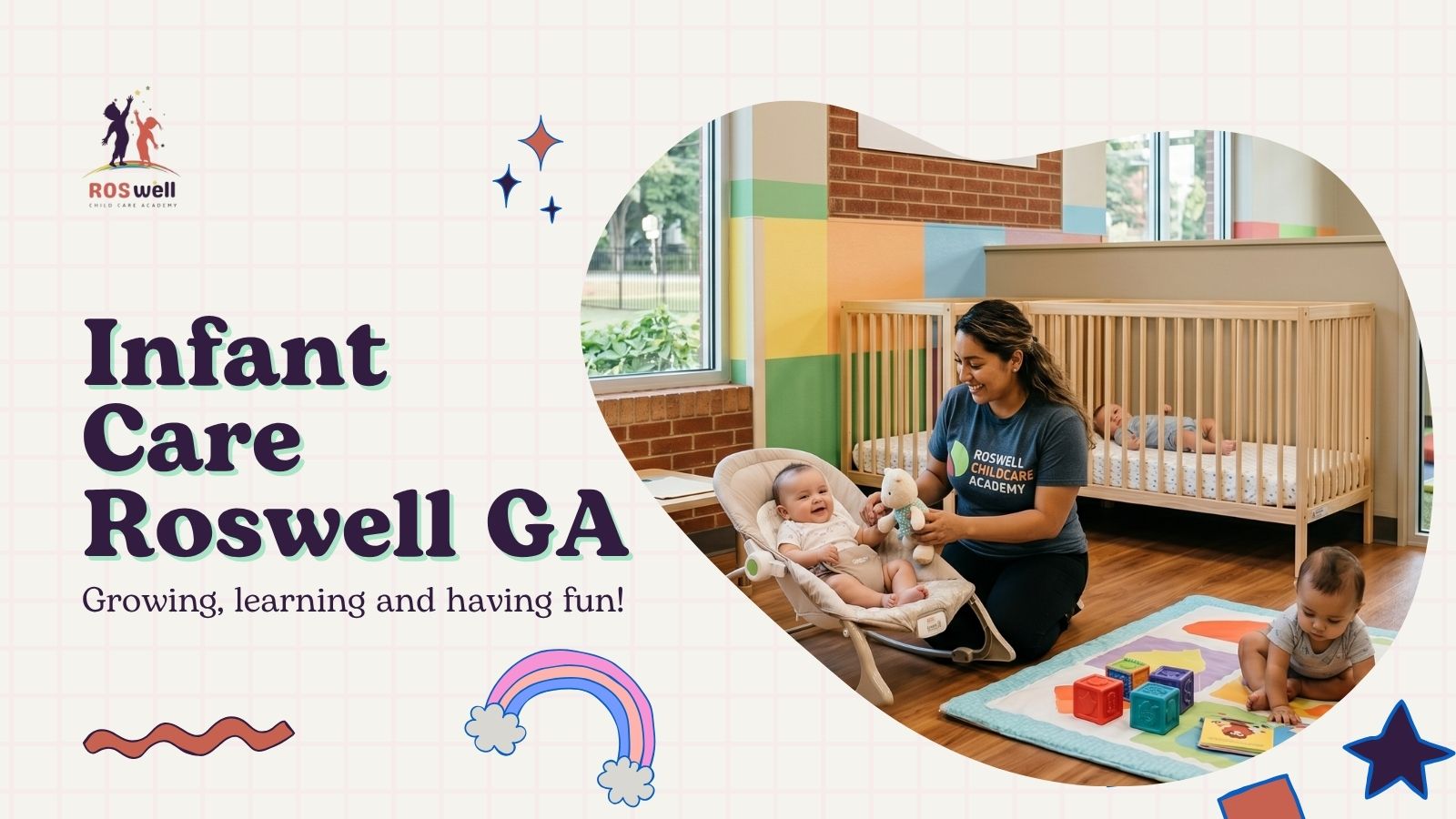
A well-designed infant room looks different from a toddler classroom or a preschool space. The best programs invest in environments specifically built around what infants need at different stages of development.
You might see:
These design choices are intentional. They reflect an understanding that the physical environment is itself a teaching tool.
No physical environment, no matter how thoughtfully designed, replaces the quality of the people caring for your child. In strong infant programs, caregivers have formal training in early childhood development, understand infant first aid and CPR, and receive ongoing professional development.
Look for programs where caregivers:
Emotional intelligence the ability to recognize, understand, and manage emotions begins developing in the first year of life. When a caregiver names an infant’s feelings (“You seem frustrated. Let’s try a different toy.”), they are doing something more significant than it might appear. They are helping the child build the neural architecture for emotional awareness.
Programs that prioritize emotional development understand that an infant who feels emotionally safe is better positioned to learn. Stress and emotional insecurity are not neutral states they actually interfere with cognitive development. So, creating a warm, responsive environment is not separate from academic readiness. It is the foundation of it.
The best caregivers understand that emotional support happens in ordinary moments, not special lessons. Some practical ways quality programs build emotional intelligence include:
Some parents wonder whether social interaction is really relevant for babies under twelve months. Research suggests it is even in very young infants. Babies are observant and absorb information about the social world around them from the beginning.
In a group care setting, infants observe other children, hear different voices, and gradually begin to show awareness of and interest in peers. By the time they reach the toddler stage, children who have been in group care tend to show stronger social awareness than those who have been in completely isolated care environments.
The transition from infancy to toddlerhood is significant. Children at this stage develop mobility, stronger communication needs, and an emerging sense of independence that requires a very different kind of support. Programs that offer daycare in Roswell for both infants and toddlers have an advantage here. When a child transitions to a toddler room within the same facility, familiar caregivers are often still present, familiar routines carry forward, and the adjustment is much smoother for the child.
This continuity of care is something parents should ask about directly when choosing a program. A facility that handles transitions thoughtfully demonstrates a real understanding of child development.
When most people think about school readiness, they picture knowing the alphabet or being able to count to ten. But educators and child development specialists define readiness much more broadly. A truly school-ready child is one who can:
All of these skills are built long before a child enters preschool — in the daily routines, relationships, and experiences of infant and toddler care.
Language development is one of the most powerful predictors of long-term academic success. And it begins from day one. Infants who are talked to frequently, whose sounds are responded to, and who hear rich vocabulary in context develop stronger language skills by the time they reach school age.
Quality programs understand this. Caregivers are trained to narrate, converse, sing, and read aloud not just when it is “activity time,” but throughout the entire day.
Before anything else, a program must meet rigorous safety standards. This includes proper licensing, appropriate staff-to-child ratios for infants, secure entry and exit procedures, and strict adherence to safe sleep guidelines.
When visiting a facility, parents should observe:
The best programs treat parents as essential partners, not passive observers. Regular communication daily reports, check-ins during pickup, and proactive outreach if something seems off tells you a lot about how a program values its relationship with families.
Parents should also feel genuinely welcome to ask questions, observe, and be involved in their child’s daily experience. A program with nothing to hide will make this easy.
Physical development and health are inseparable from cognitive and emotional growth. Programs that take feeding seriously supporting breastfeeding, accommodating individual feeding schedules for very young infants, and providing developmentally appropriate nutrition as children grow demonstrate a holistic understanding of child wellness.
Toddler daycare in Roswell programs that bridge infancy and early childhood typically offer structured mealtimes with nutritious options and active movement built into the daily schedule. These practices matter not just for physical health but because sleep, nutrition, and movement all directly affect a child’s mood, attention, and ability to learn.
One of the concerns parents often raise about group care is whether their child will receive individualized attention. This is a legitimate concern and worth asking about directly. Strong programs train caregivers to observe each child’s developmental progress, adjust their interactions accordingly, and communicate what they notice with parents.
A child who reaches a milestone early deserves enrichment. A child who needs more time with a particular skill deserves patience and adapted support. Both are possible in a group setting when the program is run well.
The early months and years of your child’s life are not a waiting room for “real” school. They are the most formative period of human development, and the environments children spend time in during those years leave lasting impressions on who they become.
Infant Care Roswell GA programs that are built on sound developmental principles, qualified caregivers, intentional environments, and genuine family partnerships give children more than just a safe place to spend the day. They give them the tools emotional, social, cognitive, and physical that they will draw on for the rest of their lives.
Families looking for quality daycare in Roswell or toddler daycare in Roswell deserve to feel confident that their choice is grounded in real knowledge of child development, not just a convenient location and a clean facility.
At Children’s Campus of Roswell, the commitment to every child’s growth is at the center of everything we do. If you are ready to take the next step, we encourage you to schedule a tour, meet our caregivers, and see firsthand how we support your child’s early development every single day. Your child’s future starts now and we would be honored to be part of it.
Most quality infant care programs accept children as young as six weeks old. At this age, infants benefit from responsive, structured care environments even though their learning looks very different from older children. When looking for a program, confirm they accept young infants and ask about their specific caregiver-to-infant ratio for babies under twelve months, which should be lower than for older age groups.
Start by verifying the program holds a valid state childcare license and has no outstanding violations. During a visit, observe how caregivers interact with infants, check that sleep areas follow current safe sleep guidelines (firm mattresses, no loose bedding), and ask about their emergency procedures and illness policies. A safe program will welcome your questions and have clear, documented answers.
Quality caregivers talk to infants throughout the day during diaper changes, feeding, play, and transitions. They narrate actions, ask questions even before babies can answer, and respond to infant sounds and gestures. This consistent verbal interaction builds the neural pathways for language that children need before they ever begin speaking words. Research consistently shows that the volume and quality of early verbal interaction predicts later language outcomes.
In a well-run infant program, yes. Licensed facilities are required to maintain specific caregiver-to-infant ratios often one caregiver for every three to four infants. Within those small groups, trained caregivers observe each child’s individual development, adapt their care accordingly, and provide one-on-one interaction throughout the day. Ask any program you visit how they track individual milestones and communicate progress to parents.
The primary differences are in the physical environment, daily routines, and developmental goals. Infant rooms are designed for non-mobile and early mobile children, with a focus on attachment, sensory development, and responsive caregiving. Toddler rooms support increasing independence, language development, early social skills, and structured group activities. A good program offers continuity between these two stages so transitions feel natural and supportive for the child.
Most programs recommend a gradual transition starting with shorter days and building up over one to two weeks. Bring a familiar comfort item if the program permits. Share your child’s home routine with caregivers so they can mirror it as closely as possible. Expect some tears at drop-off; this is normal and usually resolves much faster than parents expect. Ask staff to communicate how your child is settling throughout the day so you can feel reassured.
The foundation of emotional development in infancy is secure attachment, which comes from consistent, responsive care. When caregivers respond reliably to an infant’s needs, name emotions, maintain calm tones, and provide comfort during distress, they are literally shaping how a child’s brain learns to regulate feelings. Programs that prioritize low turnover among caregivers and thoughtful, intentional interactions support this process far more effectively than those focused only on physical safety.
Ask about caregiver qualifications and turnover rates, the caregiver-to-infant ratio, how they handle safe sleep, their daily communication with parents, how they manage transitions between infant and toddler rooms, and their approach to responsive caregiving. Pay attention to how caregivers interact with the children already in their care that real-world behaviour tells you far more than any policy document will.




Comments are closed