- Email: roswellchildcareacademy@gmail.com
- Phone: 470-282-1521

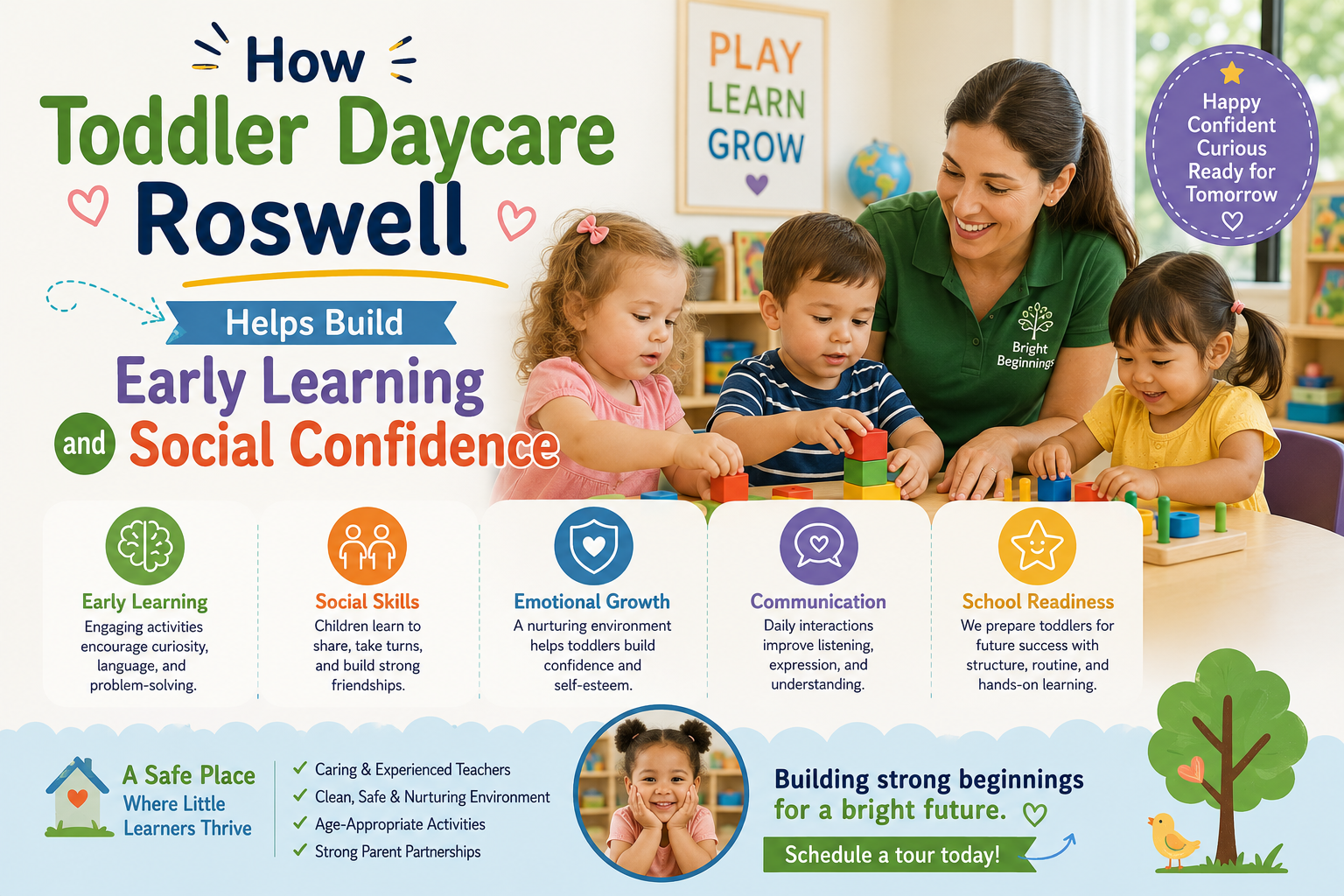
Toddler daycare in Roswell helps young children build early learning and social confidence through daily routine, guided play, and time with peers. In a safe, structured setting, toddlers practice language, sharing, and problem-solving while caring teachers support each milestone, preparing them emotionally and academically for preschool.
If you’ve ever stood at the door watching your toddler cling to your leg, wondering whether daycare is the right call, you’re not alone. Most parents feel a knot in their stomach the first time they consider it. Will my child be okay without me? Are they too young? Am I missing something at home that they need? These questions are normal, and honestly, they show how much you care.
Here’s the thing a lot of parents don’t realize until later: the toddler years, roughly ages one to three, are some of the busiest brain-building years a person will ever have. Choosing the right toddler daycare in Roswell isn’t just about having somewhere safe to leave your child while you work. It’s about giving them a place to grow language, make their first friends, and learn how to handle a world that doesn’t always go their way.
That last part matters more than people think. Confidence in little kids doesn’t come from being told they’re great. It comes from trying things, struggling a little, and figuring it out with gentle support nearby. A good daycare creates dozens of those small moments every single day.
In this article, we’ll walk through what quality care actually looks like, the mistakes parents commonly make, and how the right environment shapes your child’s mind, heart, and readiness for school. By the end, you’ll feel a lot clearer about your decision.
When people picture daycare, they sometimes imagine a room full of kids being watched until pickup. Quality care is so much more than supervision. A strong toddler daycare in Roswell is built around how young children actually learn, which is through play, repetition, and relationships.
Toddlers learn by doing. They stack blocks and knock them down forty times because each time teaches them something about balance, cause, and effect. They scribble before they ever write a letter. They babble before they form sentences. Good teachers know this, so they don’t push kids to perform. Instead, they set up the room and the day so learning happens almost by accident.
A few of the real benefits parents notice:
Early childhood specialists often point out that the goal at this age isn’t academics in the traditional sense. It’s building the foundation, things like attention, curiosity, and emotional steadiness, that all later learning sits on top of. A child who feels secure and curious will be ready to learn letters and numbers when the time comes.
One thing worth keeping in mind as a parent: every toddler adjusts at their own pace. Some kids walk in waving goodbye on day three. Others cry at drop-off for weeks before they settle. Neither one is a sign of a problem. Patience and consistency from both you and the staff usually smooth it out.
Picking a daycare can feel overwhelming, and stress sometimes pushes us toward decisions we’d rethink with a clearer head. Here are three mistakes that come up again and again, plus what to do instead.
It’s completely understandable. Childcare is expensive, and budgets are real. But the cheapest option can cost you in ways that don’t show up on a bill. Low pay often means high staff turnover, and toddlers form deep attachments to their caregivers. When teachers keep leaving, kids feel that loss.
Instead of asking only “How much?”, ask “What am I getting for this?” Look at the teacher-to-child ratio, the experience of the staff, and how long they tend to stay. Sometimes a slightly higher cost buys far more stability.
A website can look polished while the actual classroom tells a different story. Some parents enroll without ever walking through the doors, then feel uneasy later. You learn so much in ten minutes of watching a room.
Visit during a normal day, not a scheduled open house. Notice the tone. Are teachers down on the floor talking with kids, or standing back? Do the children seem relaxed and engaged? Trust your gut. If something feels off, it probably is.
Parents often focus on the building and forget to ask how they’ll actually hear about their child’s day. Then they spend months feeling out of the loop and anxious.
Ask directly: How do you keep parents updated? Do you send photos or notes? How do you handle a tough day or a small injury? A center that communicates openly treats you as a partner, which is exactly what you want during these years.
The early years lay tracks the brain follows for a long time. A nurturing childcare in Roswell supports growth across four key areas at once. Here’s how it plays out day to day.
Notice that these don’t happen in separate boxes. A toddler resolving a squabble over blocks is doing social work and emotional work and language work all at once. That’s the beauty of play-based learning. It teaches the whole child.
Childcare keeps evolving, and parents today expect more than a generation ago did. A few clear directions stand out heading into 2026.
First, there’s a strong move toward play-based, child-led learning. The old idea of drilling toddlers on flashcards has largely fallen out of favor among early education experts. Research keeps confirming what good teachers always knew: young kids learn best through hands-on play, not worksheets.
Second, emotional skills are getting real attention. Centers increasingly teach toddlers to recognize feelings and calm themselves, sometimes called early social-emotional learning. Parents have come to value this as much as ABCs, because a child who can manage frustration handles school and life better.
Third, communication has gone digital and frequent. Many families now expect daily app updates with photos, meal notes, and nap times. It’s not about hovering. It’s about staying connected when you can’t be there.
Fourth, parents care more than ever about safe, healthy environments. Clean spaces, sensible health practices, secure entry, and proper supervision are non-negotiable. Families also look for outdoor time and nutritious food as part of the package.
The expert consensus is refreshingly simple: pick a place where your child is known, loved, kept safe, and free to explore. Fancy curriculums matter far less than warm, consistent caregivers who genuinely enjoy being with little kids.
Roswell families generally weigh a few different paths. There’s no single right answer, since it depends on your child, your budget, and your schedule. This table lays out the trade-offs so you can see them side by side.
| Feature | Toddler Daycare Center | In-Home Care / Nanny |
|---|---|---|
| Social interaction | High; daily time with peers | Limited unless arranged separately |
| Structured learning | Strong, with planned activities and routine | Varies a lot by the caregiver |
| Cost | Moderate, often per child | Often higher, especially for one child |
| Consistency if a caregiver is sick | Backup staff keep things running | Care may stop entirely that day |
| Socialization for shy kids | Built-in, gentle practice every day | Needs extra effort to create |
| Personalized attention | Shared across a group | Very high, one-on-one |
| School readiness prep | Built into the daily program | Depends on the individual |
| Parent communication | Often app-based and regular | Direct but informal |
For many parents, the deciding factor is socialization. If you want your toddler around other children, learning to share and make friends before preschool, a center has a clear edge. If your child has specific needs that call for one-on-one focus, in-home care may fit better. Plenty of families even blend both over time.
Once you understand the options, the choice gets easier. Here are practical steps that genuinely help.
Start by listing what matters most to you. Maybe it’s location near work, maybe it’s a particular learning style, maybe it’s hours that match your shift. When you know your priorities, you stop chasing the “perfect” center and start finding the right one.
Then go and visit. Bring your child if you can, and watch how the staff respond to them. A teacher who crouches down to say hello tells you a lot.
Ask about the boring-but-crucial stuff: ratios, staff turnover, sick policies, nap arrangements, and how they handle discipline. The answers reveal the center’s real values.
Talk to other parents. A quick conversation at pickup or an honest online review (read several, not one) gives you a feel for the day-to-day.
Finally, trust the trial period. Most kids need a few weeks to adjust. Give it real time before you judge, but also stay alert. If your child seems consistently unhappy after a fair adjustment, or if communication breaks down, it’s okay to make a change. You know your child best.
Roswell is the kind of community where families put a lot of thought into their children’s early years. Many local parents juggle demanding jobs while still wanting their kids close to home, in a place that feels personal rather than institutional.
That’s part of why quality toddler daycare in Roswell has become such a priority for young families here. Parents aren’t just looking for supervision. They want their children to grow into curious, kind, capable little people who walk into preschool ready and confident.
The good news is that families in Roswell have thoughtful early education options to choose from, with programs that focus on play, language, social skills, and the steady routines toddlers love. The strongest centers feel like an extension of home: warm teachers who learn your child’s name and quirks, spaces designed for small hands and big imaginations, and open communication that keeps you in the loop.
Whatever you choose, the priorities most local families share are simple and right on target. They want their toddlers safe, happy, learning through play, and building the confidence that will carry them for years. Keeping those goals front and center makes the whole search far less stressful.
When you tour any program, run through this quick checklist. These are the things that separate good care from the rest.
If a center checks these five boxes, you’re likely in good hands.
Choosing care for your toddler is one of those decisions that feels enormous, and that’s because it is. But it doesn’t have to be scary. When you understand what quality care actually looks like, the path forward gets a lot clearer.
We’ve covered a lot of ground. The toddler years are prime time for brain growth, and the right setting nurtures language, independence, friendships, and emotional steadiness all at once. We looked at common mistakes, like choosing on price alone, skipping the visit, or overlooking communication, and how to sidestep them. We walked through how good care shapes cognitive, social, and emotional growth while quietly building school readiness. And we compared your options so the trade-offs are easy to see.
The heart of it is this: little kids grow best where they feel safe, known, and free to explore. Confidence isn’t taught with words. It’s built through hundreds of small moments of trying, stumbling, and succeeding with a caring adult nearby. A strong toddler daycare in Roswell creates exactly those moments, day after day.
If you’re a parent weighing daycare in Roswell, take your time, trust your instincts, and visit a few places in person. Quality childcare in Roswell is out there, and finding the right fit can make these early years smoother for the whole family. Roswell Child Care Academy is one option worth exploring as you look for a warm, learning-focused environment for your little one.
Your toddler is ready to grow, make friends, and surprise you with how much they can do. The right place will help them shine. Go take that next step, schedule a visit, ask your questions, and picture your child thriving there. You’ve got this, and so do they.
Many children start between 12 and 18 months, though some begin earlier and others wait until closer to two. There’s no single right age. What matters most is your family’s needs and your child’s readiness. Toddlers are highly social and benefit from peer interaction, so this window is a great time to build early skills. Visit a few centers, watch how your child responds, and pick a start date that works for your routine and your comfort level as a parent.
Most toddlers settle within two to six weeks, though every child is different. Some wave goodbye happily within days, while others cry at drop-off for a while before warming up. Both are completely normal. A consistent routine, a quick and confident goodbye, and a caring teacher who comforts your child all speed things along. If your toddler still seems deeply unhappy after a fair adjustment period, talk with the staff to figure out what might help.
Daycare generally serves younger children, including infants and toddlers, with full-day care focused on safety, routine, play, and basic development. Preschool usually starts around age three and leans more toward structured early learning that prepares kids for kindergarten. The line blurs, though. Many quality daycare programs include plenty of learning, and many preschools offer full-day care. For a toddler, daycare with a play-based, developmental approach is typically the right fit.
Look for low teacher-to-child ratios, experienced staff who stay long-term, clean and safe spaces, and warm interactions between teachers and kids. Quality centers communicate openly, welcome visits, and focus on play-based learning rather than drilling. Watch a normal day if you can, and notice whether children seem relaxed and engaged. Ask other parents about their experience. Trust your gut, too. If a place feels caring and organized, that’s a very good sign.
Often, yes. Daycare gives shy children gentle, daily practice being around peers, which is hard to replicate at home. Skilled teachers ease kids into group play without pushing, letting them watch and join at their own pace. Over time, many quiet toddlers grow noticeably more confident and comfortable. Be patient, since shy children may take longer to settle. Celebrate small wins, and let the caregivers know your child’s personality so they can support the adjustment.
Costs vary based on hours, program type, and the specific center, so it’s best to request current pricing directly from a few places near you. When comparing, look beyond the price tag at what’s included, such as meals, learning activities, ratios, and staff experience. The cheapest option isn’t always the best value, since stable, well-trained teachers make a big difference for toddlers. Ask about any registration fees, supply costs, or part-time options that might fit your budget.
Quality daycare can be very beneficial. It supports language growth, social skills, independence, and emotional development through play, routine, and time with peers. Toddlers learn to share, follow simple directions, and manage feelings with caring adults nearby, all of which build school readiness. The key word is quality. A warm, safe, well-run program helps kids thrive. Look for engaged teachers, a play-based approach, and a setting where your child feels secure and happy.
Most centers provide a list, but common items include a few changes of clothes, diapers and wipes if needed, a comfort item like a small blanket or stuffed animal, a labeled water bottle, and any required forms or medications. Label everything with your child’s name. A familiar object can ease separation anxiety those first days. Ask the center about their nap, meal, and supply policies ahead of time so you arrive prepared and your toddler’s first day goes smoothly.




Comments are closed