- Email: roswellchildcareacademy@gmail.com
- Phone: 470-282-1521
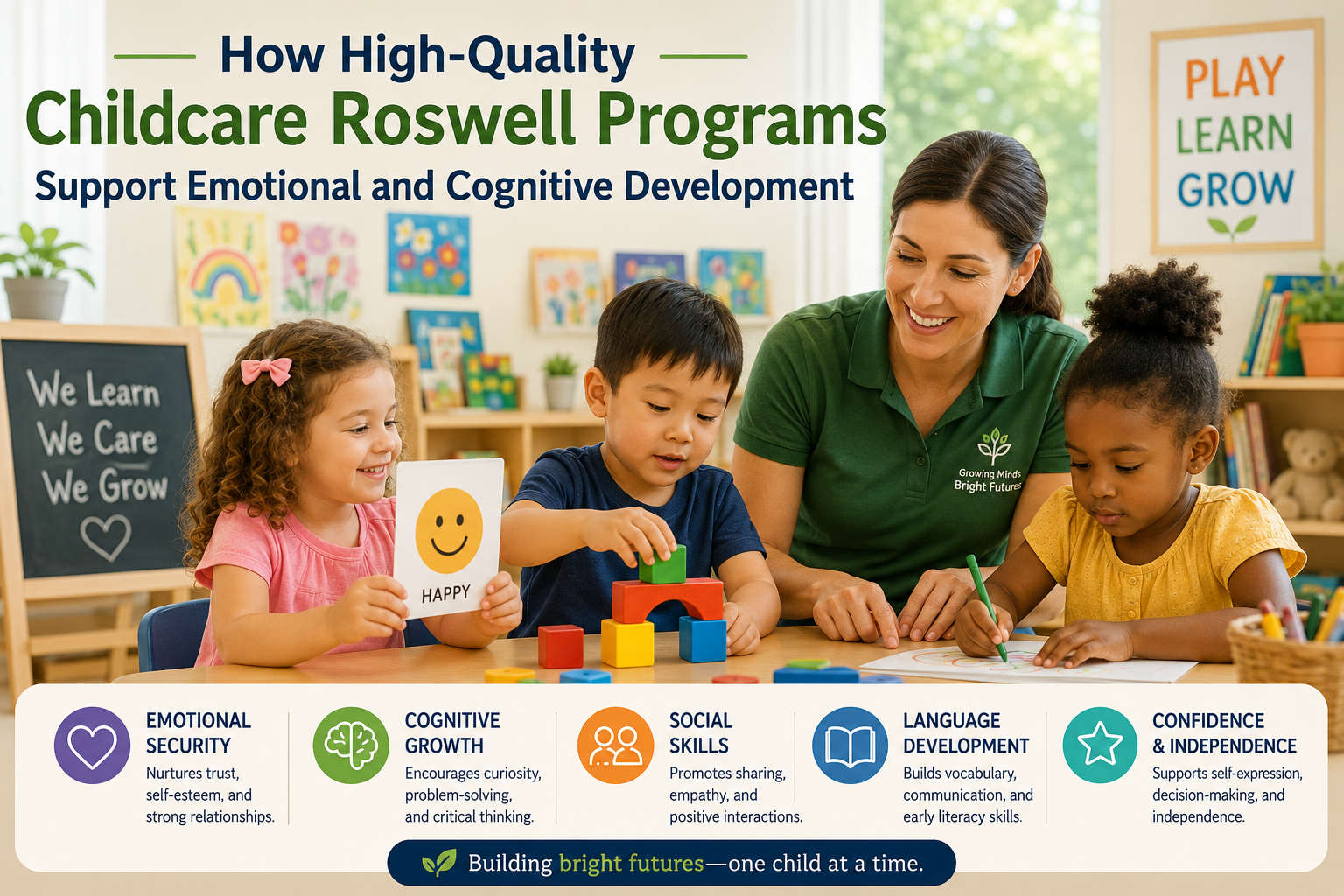
High-quality childcare Roswell programs support emotional and cognitive development by pairing warm, consistent caregiving with play-based learning. Children build language, problem-solving, and self-regulation skills through daily routines, peer interaction, and responsive teachers who notice and respond to each child’s needs as they grow.
If you’ve ever stood in your kitchen at 6 a.m., coffee in one hand and your child’s tiny shoe in the other, wondering whether the place you’re dropping them off is actually good for them, you’re not alone. Most parents I talk with aren’t worried about whether their child will be fed or safe. They assume that much. What keeps them up at night is harder to name. Will my child be happy here? Will someone notice when she’s sad? Is he learning anything, or just being watched?
Those questions matter more than we sometimes admit. The early years aren’t a holding pattern before “real” school starts. They’re the years when the brain builds its fastest, when a child decides without words — whether the world is a safe place to explore. Choosing childcare in Roswell isn’t just a logistics problem to solve before Monday. It’s one of the first big decisions you’ll make on your child’s behalf, and it touches both how they feel and how they think.
The good news is that you don’t need a degree in early education to choose well. You need to know what strong programs actually do, what to watch for, and which mistakes trip up even loving, careful parents. That’s what the rest of this guide is for.
It’s easy to picture childcare as a place where kids are kept busy until pickup. The best programs are doing something far more deliberate, even when it looks like ordinary play.
When a toddler stacks blocks and watches them topple, she’s testing cause and effect. When a four-year-old negotiates whose turn it is on the swing, he’s practicing emotional regulation and early social reasoning. A skilled teacher sees those moments for what they are and gently stretches them adding a word here, asking a question there, stepping back when a child is figuring something out on their own. That blend of structure and freedom is the quiet engine behind healthy development.
A few things separate genuinely strong programs from the rest:
Parents often ask me what to prioritize. My honest answer: warmth first, then everything else. A beautiful facility with cold caregivers will do less for your child than a modest room run by people who clearly delight in kids. Worksheets can wait. A child who feels seen is a child who is ready to grow.
It also helps to picture development over weeks and months, not single days. Some afternoons your child will come home tired or cranky, and that’s normal. What you’re really watching for is the slow, steady arc: more words, more confidence, more willingness to try. A strong program won’t produce dramatic breakthroughs every day. It produces small, reliable progress that adds up to a child who feels capable in the world and that quiet momentum is exactly what good early care is designed to create.
I’ve watched thoughtful parents make the same handful of missteps, usually for understandable reasons. Knowing them ahead of time can save you a lot of second-guessing later.
Cost and commute are real. Nobody can pretend otherwise. But the cheapest or closest option isn’t automatically the right one, and the priciest isn’t automatically the best. What matters is the daily experience your child has the ratio of adults to children, the warmth of the staff, the rhythm of the day. Tour at least two or three places before you decide, even when one seems obviously convenient. The difference between programs is often invisible on a website and obvious within ten minutes of a visit.
A clean lobby and a glossy curriculum brochure tell you very little. During a visit, watch the adults. Do they get down on the children’s level? Do they speak kindly, even when a child is melting down? Is the room calm or chaotic? You’re looking for caregivers who treat children as people, not as a group to be managed. This single observation predicts more about your child’s experience than any printed philosophy.
Some parents feel pressure to find a program that drills letters and numbers as early as possible, worried their child will fall behind. For preschool-age children, this usually backfires. Pushed-too-early academics can drain the joy out of learning. Genuine preschool readiness grows from curiosity, confidence, and self-regulation not from flashcards. The strongest early programs build those underlying skills, and the academics follow far more easily later.
Good early care doesn’t develop one skill at a time. It works on the whole child at once. Here’s how that plays out across the areas parents care about most.
Notice that none of these happen in isolation. A child who feels emotionally safe is more willing to take cognitive risks. A child with strong language skills makes friends more easily. Development is a web, and high-quality care tends to all the threads at once.
Early education keeps evolving, and a few shifts are worth knowing about as you compare programs this year.
The biggest change is how seriously the field now takes emotional skills. For years, “school readiness” mostly meant counting and letters. Today, leading educators put nearly equal weight on self-regulation, resilience, and social-emotional learning. Programs are training staff to coach children through big feelings rather than simply redirect them, and parents are increasingly expecting that kind of care.
There’s also a stronger pull back toward play-based and nature-based learning, partly as a response to too much screen time elsewhere in children’s lives. Many quality programs now protect generous blocks of unstructured and outdoor play, treating it as essential rather than optional.
Modern parent expectations have shifted, too. Families in 2026 want real transparency frequent photos, clear updates, easy ways to ask questions, and honest conversations when something goes wrong. The best programs have leaned into this, using simple communication apps and open-door policies so parents never feel shut out of their child’s day.
My recommendation when you’re touring: ask how a program handles a child who’s struggling emotionally or behaviorally. The answer reveals whether their warmth is real or just marketing. Programs that respond with patience and a plan, rather than punishment or vague reassurance, are the ones worth your trust.
Parents often use “daycare” and “preschool” interchangeably, but they tend to differ in focus. Here’s a simple comparison to help you think it through. Keep in mind that many quality programs blend both.
| Feature | Daycare in Roswell | Preschools in Roswell |
|---|---|---|
| Typical ages | Infants through preschool | Roughly 3 to 5 years |
| Main focus | Full-day care plus development | Structured early learning |
| Hours | Often full-day, year-round | Often part-day or school-year |
| Learning style | Care-centered with play and routine | Curriculum-guided with play |
| Best for | Working parents needing full coverage | Building pre-kindergarten skills |
| Social setting | Mixed ages common | Same-age peer groups |
Neither is “better” in the abstract. A full-time working family may need the longer hours of daycare, while a family focused on a strong kindergarten runway might lean toward a preschool program. The right answer depends on your schedule, your child’s age, and what your child needs most right now.
Once you understand what to look for, the choice becomes far less overwhelming. Here’s a practical path forward.
Start by visiting in person, ideally during active hours rather than nap time, so you can see the program in motion. Bring your child if you can, and watch how the staff greet them. Trust your gut about the energy in the room children are wonderfully honest barometers, and so is your own instinct.
Ask direct questions and listen for direct answers. How many children per teacher? How long have the staff been there? How do they handle illness, injuries, and tough behavior? How will they keep you in the loop? A confident program welcomes these questions; a defensive one tells you something, too.
Then give it a short trial period if possible. Watch how your child settles in over the first couple of weeks. Some tears at drop-off are normal and usually fade. What you want to see is a child who, over time, walks in a little more easily and comes home talking about a friend, a teacher, or something they made. That’s the real signal that you chose well.
Finally, remember that no program is perfect, and you can change course if something isn’t working. Choosing care is a decision you’re allowed to revisit. Staying attentive matters more than getting it flawlessly right the first time.
Families in Roswell juggle the same realities families everywhere do work schedules, long commutes, and the universal wish to give their children a strong start. What’s encouraging is that the Roswell area offers a real range of early education options, from full-day care for the youngest children to preschool programs aimed at building pre-kindergarten skills.
For many local parents, the priorities are consistent: a safe environment, caring teachers who stay for the long haul, and a place where a child’s development is taken seriously without rushing childhood. Roswell’s community feel works in families’ favor here. Smaller, relationship-driven programs are often able to know each child by name, notice their quirks, and partner closely with parents exactly the conditions in which young children flourish.
If you’re weighing your choices in the area, focus less on which option sounds the most impressive and more on which one fits your child and your family’s daily life. The best fit is rarely the flashiest. It’s the place where your child is known, your questions are welcomed, and you can leave each morning without that knot in your stomach.
It also helps to talk with other local parents. Word of mouth in a community like Roswell carries real weight, because the families around you have already lived through the same drop-off worries and adjustment periods. Ask neighbors and coworkers what they wish they’d known before enrolling. Their stories won’t make the decision for you, but they often surface the small, practical details staff consistency, how a program handled a sick week, how welcomed they felt that rarely show up on a tour.
When you tour any program, keep this short checklist in mind. These are the things that consistently separate dependable care from the rest:
If a program checks these boxes and your gut feels at ease, you’re likely in good hands.
Choosing where your child spends their days is rarely simple, but it doesn’t have to be frightening. Once you understand what strong programs do responsive caregiving, predictable routine, language-rich days, and purposeful play the right choice tends to reveal itself. The early years shape both how a child feels and how a child thinks, and the care you choose plays a real part in that story.
Remember the patterns worth avoiding: deciding on price or location alone, overlooking how staff actually treat children, and pushing academics before a child is ready. And remember what truly matters across cognitive development, social skills, emotional growth, communication development, and preschool readiness all of which grow best in a setting where your child feels safe, seen, and free to explore. The shift in 2026 toward emotional skills, play-based learning, and honest communication only makes those priorities clearer.
Quality childcare Roswell families can trust isn’t about the fanciest building or the longest list of activities. It’s about warmth, consistency, and people who genuinely care for your child. Whether you’re comparing daycare in Roswell for full-day coverage or preschools in Roswell to build kindergarten readiness, trust your observations and your instincts.
If you’re ready to take the next step, a thoughtful, relationship-centered program like Roswell Child Care Academy is worth a visit. Tour in person, watch how your child is welcomed, and ask every question on your mind. Your child deserves a place where they’re nurtured and challenged in equal measure and you deserve the peace of mind that comes with knowing you chose well. Schedule a visit, trust what you see, and take that first confident step today.
There’s no single right age it depends on your family’s needs and your child’s temperament. Many families begin care during infancy when returning to work, while others wait until age two or three for more social interaction. What matters most is the quality of the program and how well your child is supported. A warm, responsive setting benefits children at almost any starting age, so focus on fit rather than a magic number.
Visit in person and watch how staff interact with children. Look for warmth, calm energy, reasonable adult-to-child ratios, and low staff turnover. Notice whether the space is safe, clean, and full of age-appropriate materials. Ask how they communicate with parents and handle difficult moments. A quality program welcomes your questions and gives clear answers. Often, your own gut feeling during a short visit tells you as much as any brochure.
Yes, when the care is high quality. Young children develop emotional skills through relationships with consistent, caring adults who help them name feelings, calm down, and recover from frustration. Group settings also give children daily practice with sharing, waiting, and resolving small conflicts. Over time, this builds self-regulation and confidence. The key is responsive caregiving adults who notice and respond to a child’s emotions rather than simply manage behavior from a distance.
Daycare generally provides full-day care across a wider age range, often year-round, with a focus on care plus development through play and routine. Preschool usually serves children around ages three to five, with more structured early learning aimed at kindergarten readiness, sometimes on a part-day or school-year schedule. In practice, many quality programs blend both. The best choice depends on your child’s age, your work hours, and your family’s priorities.
Expect some tears at drop-off at first this is normal and usually fades within a couple of weeks. Keep goodbyes short, warm, and consistent, and avoid sneaking out, which can increase anxiety. Talk positively about the program at home, and bring a comfort item if it’s allowed. Stay in touch with teachers about how your child is settling in. Over time, look for signs of comfort, like talking about friends or activities from their day.
Very important. Routine and consistency help young children feel safe because they know what to expect next. That sense of security is exactly what frees a child to explore, try new things, and bounce back from frustration. Predictable rhythms snack, story, play, rest also support self-regulation and smoother transitions throughout the day. When you tour a program, ask about the daily schedule. A clear, age-appropriate routine is a strong sign of a well-run environment.
Not if the program builds the right foundation. For young children, genuine school readiness comes from curiosity, confidence, language, and self-regulation rather than early drilling of letters and numbers. Strong programs develop these underlying skills through play and conversation, and formal academics tend to follow far more easily later. In fact, pushing academics too early can drain a child’s love of learning. Trust play-based learning it’s doing more than it appears to.
Ask about adult-to-child ratios, staff experience, and how long teachers typically stay. Find out how they handle illness, injuries, and challenging behavior, and how they keep parents informed day to day. Ask to see a typical daily schedule and the outdoor space. Request a tour during active hours, not nap time. A confident, caring program will welcome these questions and answer them clearly and how they respond tells you a great deal about the experience your child will have.




Comments are closed