- Email: roswellchildcareacademy@gmail.com
- Phone: 470-282-1521
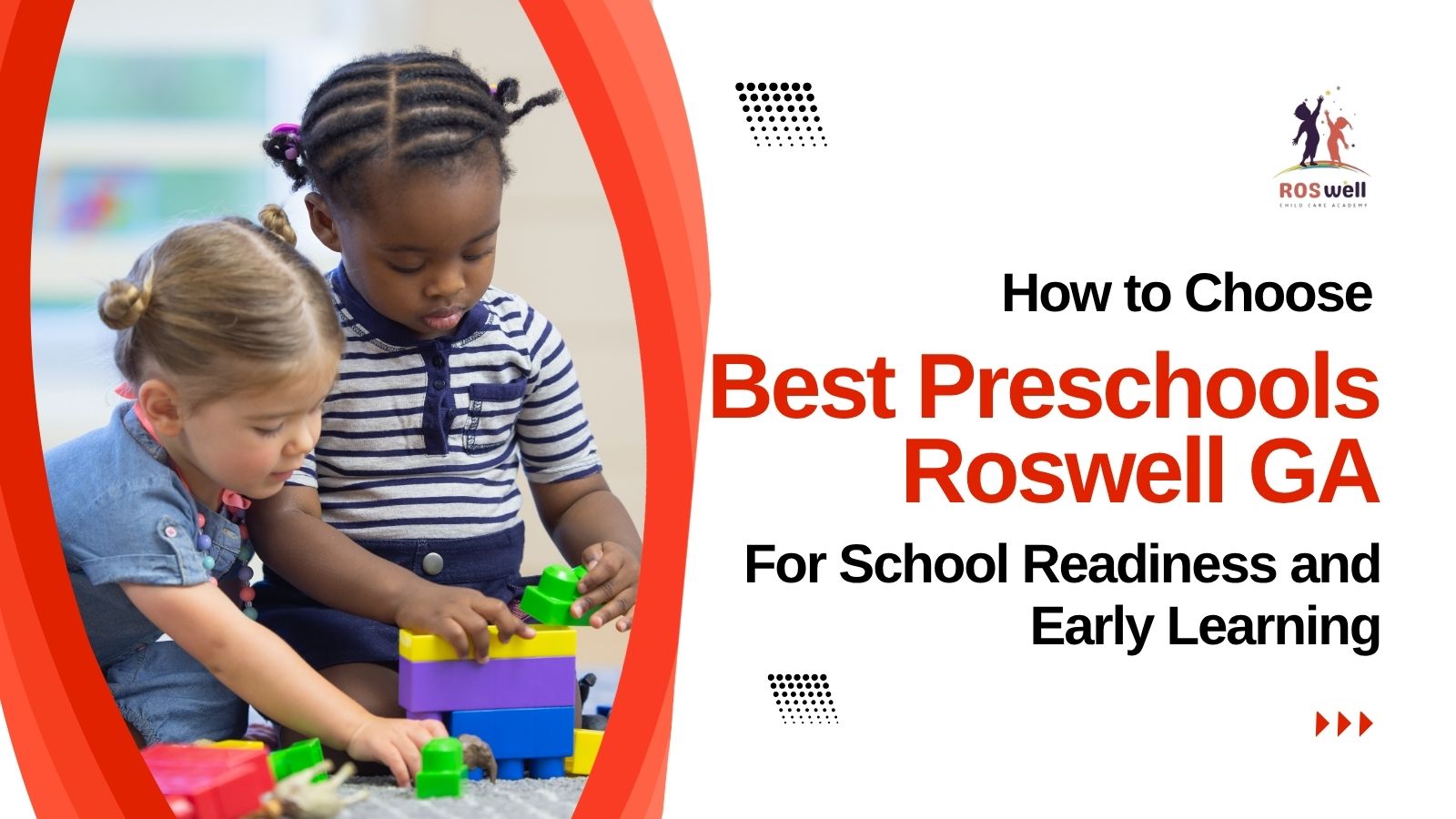
Choosing a preschool is one of the most important decisions you will make for your child in their early years. Parents across Roswell are looking for preschools Roswell GA that go beyond basic babysitting and actually prepare children for kindergarten and beyond. And honestly, that concern is completely valid.
The early years roughly from age two to five are when a child’s brain develops faster than at any other point in life. The learning environment, the quality of teachers, the daily routines, and even how a child is comforted during a hard day all shape how they think, communicate, and connect with others for years to come.
This article will walk you through everything you need to consider when selecting a preschool in Roswell. From understanding what school readiness really means to knowing the right questions to ask during a tour, this guide is designed to help you feel informed, confident, and ready to make the best choice for your child.
Many parents assume school readiness is mostly about whether a child can write their name or count to ten. In reality, it covers a much broader range of skills and preschool plays a direct role in building all of them.
Academic readiness includes early literacy skills like recognizing letters, understanding that words carry meaning, and developing basic number sense. But developmental readiness covers things like:
A quality preschool program works on all of these areas together. The academic pieces matter, but so does everything else.
There is sometimes a belief that preschool is just supervised play. And while play is absolutely a powerful learning tool at this age, structured early learning programs use play intentionally. Activities are designed to build skills problem-solving, creativity, language, and cooperation in ways children absorb naturally.
Research consistently shows that children who attend high-quality early childhood programs perform better academically and socially through elementary school and beyond. The foundation built between ages three and five is genuinely that significant.
Not all programs are created equal. When evaluating options, there are specific qualities that separate truly effective early learning environments from those that simply keep children safe during the day.
The teacher is the most important factor in your child’s preschool experience. Look for educators who:
Teacher-to-child ratios also matter. Smaller group sizes mean more individual attention, which directly supports learning and emotional security.
Young children thrive on predictability. A quality preschool program will have a consistent daily schedule that includes:
When children know what to expect, they feel safe. And when they feel safe, they learn better.
Look for programs that integrate learning across multiple areas — language arts, math readiness, science exploration, music, art, and physical development. A curriculum that leans too heavily in one direction often misses the developmental picture.
The best programs use curriculum frameworks supported by early childhood research. Ask about what curriculum the school uses and how teachers are trained to implement it.
You should never feel out of the loop about your child’s progress. Strong preschool programs provide:
When teachers and families work together, children benefit directly.
Early childhood is a deeply emotional time. Children at this age are just beginning to understand their own feelings and learning how to manage them. A preschool that understands this is worth paying attention to.
Quality programs incorporate social-emotional learning (SEL) into everyday routines. This includes teaching children to:
These skills are not “soft skills.” They are foundational. Children who develop strong social-emotional skills in the early years tend to have better relationships, perform better academically, and cope more effectively with stress as they grow.
The physical environment of a classroom how it is organized, how quiet or loud it is, how materials are arranged directly affects how children feel. Calm, organized, and welcoming spaces help children settle in and feel secure.
Watch for classrooms that have:
No matter how wonderful the curriculum is, safety must be your baseline. During any preschool visit, take a careful look at the physical environment.
In Georgia, childcare programs are regulated by the Bright from the Start: Georgia Department of Early Care and Learning (DECAL). Any licensed facility must meet minimum standards for health, safety, group sizes, and staff qualifications.
Going beyond basic licensing, look for programs that hold national accreditation such as through NAEYC (National Association for the Education of Young Children). Accredited programs have voluntarily met higher standards in curriculum, staff qualifications, and family engagement.
Key safety factors to observe include:
Ask directly about sick-child policies. How does the school handle a child who develops a fever during the day? What is their procedure for managing illness outbreaks? Are staff trained in first aid and CPR?
These questions are not paranoid they are responsible. A well-run program will appreciate that you asked.
Many families in Roswell need care that extends beyond a half-day preschool program. This is where understanding the difference between preschool models becomes important.
For working parents, daycares Roswell that offer full-day, integrated learning programs can be the ideal combination of childcare and early education. The key is to look for programs where the educational component is not just an add-on but is woven throughout the entire day not just during morning “school hours.”
A strong full-day program will maintain structured learning activities, outdoor play, meal routines, and rest periods in a way that keeps children engaged and growing across the full day — not just entertained.
The enrollment process should feel like a two-way conversation. You are evaluating the school just as much as they are reviewing your child’s application. Come prepared with thoughtful questions.
Here are some of the most important ones:
Do not feel rushed during a tour. A quality program will welcome your questions and give you time to observe the environment.
The classroom itself is actually considered the “third teacher” in early childhood education — after the primary teacher and the family. The way a space is designed communicates to children what is valued and how they should engage.
Look for spaces that invite curiosity:
A classroom that is thoughtfully set up tells you that the teachers understand how children learn. It also tells you the program invests in quality materials and intentional design.
Every child is different. A program that works beautifully for your neighbor’s child may not be the right match for yours and that is okay.
Consider your child’s specific temperament and needs:
Finding a good fit is not just about the program’s reputation. It is about how your child will feel walking through the door every morning.
Choosing among the preschools Roswell GA has to offer is not a decision to rush. The right program will give your child a strong academic foundation, meaningful social experiences, and the emotional support they need to grow into a confident, curious learner.
Whether you are exploring childcare Roswell GA options for a younger toddler or looking for a structured pre-kindergarten program, the same principles apply: look for qualified teachers, intentional curriculum, clear safety standards, and open communication with families.
At the end of the day, you know your child better than anyone. Trust your instincts, ask good questions, and do not settle for a program that does not feel right. If you are considering daycares Roswell with a full-day educational component, prioritize programs where learning is integrated throughout the entire day not just in the morning hours.
If you are ready to find a preschool that combines school readiness with genuine care for your child’s growth and well-being, we encourage you to schedule a tour today and see the difference a quality early learning environment can make.
Most preschool programs accept children between ages two and a half and five. Many early childhood specialists recommend starting between ages three and four, when children have developed enough language and independence to benefit fully from a structured group setting. However, every child is different, and readiness matters more than a specific age.
Look for programs that follow a defined curriculum, maintain certified teaching staff with early childhood qualifications, and regularly track developmental milestones. Schools that offer parent-teacher conferences, progress reports, and structured learning activities throughout the day are generally focused on school readiness rather than just supervision.
For children ages three to four, most experts recommend a ratio of no more than one teacher for every eight to ten children. Smaller ratios allow teachers to give more individual attention, better support emotional development, and respond more effectively to each child’s learning pace.
This depends largely on your family’s schedule and your child’s needs. Half-day programs are a good introduction for younger children or those who need more time to adjust to group settings. Full-day programs can be beneficial for children who thrive on structure and for families who need consistent childcare. The most important factor is that the full day is educationally intentional, not just extended supervision.
Ask directly about teacher credentials during your visit or inquiry call. In Georgia, licensed programs must meet minimum staff qualification standards. The best programs go further, hiring teachers with associate or bachelor’s degrees in early childhood education and providing ongoing professional development. You can also observe whether the teacher interacts warmly, uses age-appropriate language, and genuinely engages children during your visit.
Children do not need to know the alphabet or how to count to start preschool – that is what preschool is for. What helps is basic independence skills: being able to communicate simple needs, beginning potty training (most programs require some level of toilet independence for three-year-olds), being able to separate from a parent without extended distress, and some experience in group settings like playgroups or library programs.
Good programs have thoughtful transition plans, including gradual enrollment periods where children attend for shorter times at first. Teachers are trained to comfort children and help them build trust with the new environment. They should also keep parents informed during the early weeks and communicate openly if a child is struggling longer than expected.
Accreditation is not required, but it signals that a program has voluntarily exceeded minimum standards. National accreditation through organizations like NAEYC involves a detailed self-study, parent surveys, and an on-site review. Accredited programs tend to have stronger curriculum frameworks, better-trained staff, and more consistent quality – though well-run licensed programs can also be excellent choices.
Comments are closed